No Cookies! No CSS! No unnotified AI! EV Home - EV List - Using Extension Leads with EVs - About Ham Radio
Assuming you live in an area with grid electricity available, and within a few hours of a main road or a rural city, is a Battery Electric Vehicle practical?
By EV I mean a car with a battery only, and no engine or hydrogen fuel cell, also called a BEV for Battery Electric Vehicle. Companies are increasingly calling their ICE (Infernal, oops, Internal Combustion Engine) cars EVs if they have the slightest hint of electric equipment; some ICE-only Mazda 2 models have a body coloured metal at the front, faking the look of a pure electric Mach-E. ICE was a development on the steam powered traction engine, using external combustion of wood or coal below a boiler. Oh, and it is the Australian street name for crystal methamphetamine, a dangerous stimulant.
This depends mostly on the range which the battery provides at highway speeds. While the advertised range applies to things like driving in a city where you are often coasting to a stop at lights, thus regenerating power, an advantage you don't get much in rural areas. Also, pushing through the air at highway speeds consumes energy, and can affect range compared to that published. However this happens with petrol cars especially, and diesel to a lesser extent.
There are some early EV which would not be suitable for most rural users, but something like a BYD, Polestar / Volvo / Zeekr / Geely, Cadillac (factory RHD), MG / IM, Porsche / Audi / VW / Cupra, BMW / Mini, Mercedes, Leapmotor, and the improved Toyota bZ4X or Subaru Solterra should all work well, ditto maybe the Jeep front-drive small SUV. BYD's Denza has the 7-seater D9 luxury multi-person vehicle; and Z9GT, a lift-back grand tourer / sports wagon.
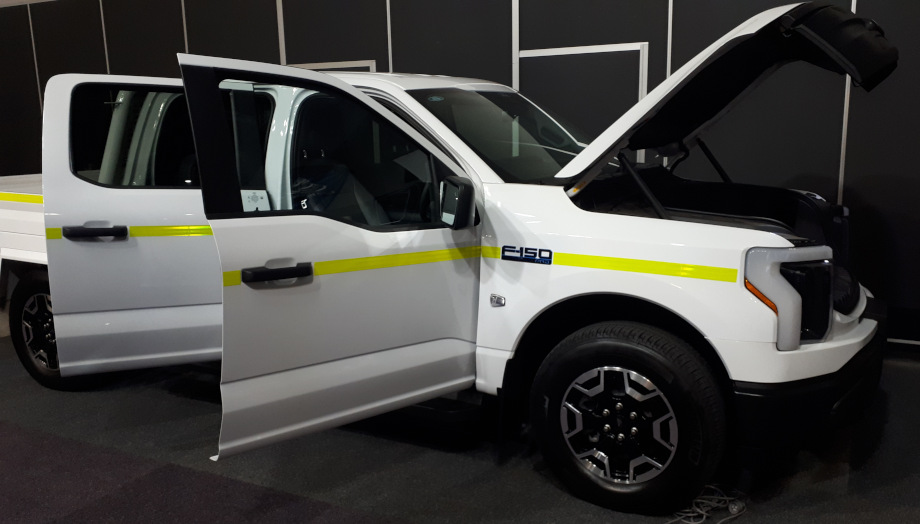
The LDV eT60 is a pickup, the Deepal E07 a combination SUV and ute vehicle. The F-150 Lightning a US Pick-up with the steering wheel moved across locally (now in the socondary market). And just launched is the all wheel drive RIDDARA RD6 dual cab-ute from Geely, with 3.5 tonnes towing capacity to totally ruin your weekend (as sQomo said they would). It has a load carrying capability over 1 tonne, potentially providing tax benefits. It makes a Ranger Raptor look a bit ordinary. The "re-manufacturing" companies importing Chevrolet and GMC pickups are doing the electric versions too. And the MG U9 EV has just been announced, towing a "weekend ruining" 3.5 tonnes of boat, or agricultural equipment, as required. Musso has an electric dual-cab ute too; Isuzu has one on the way. The Tembo Tusker is a single and dual cabs moving from mining and utilities into the general market, the former having quite a long tray.
|
| A white F-150 Lightning with lime reflective tape. The front trunk is open. |
Geely's Farizon sells high and low roof "Super Vans". If you have one built as a camper you get grid independent electric cooking! No gas, no flames, no "Am I missing... an eyebrow???" My photos from Mobility Live 2025. Their site is https://farizonauto.au/. Overseas, including in NZ, they also have electric pantechs and refrigerated delivery trucks.
The Ford E-Transit is 4.25 tonne GVM van, in factory RHD. The Mercedes Benz e-Vito is another commercial option. Small, medium, and large buses, including some with full accessibility are available. Farizon (part of Geely) has a couple of vans, perhaps the best choice.
The vast majority of rural areas, rather than remote, are within 300 km of a town with a medium or high rate charger. An IM5 Platinum sedan sold by MG has a range of 655 km, up there with many petrol models. Unlike an economical ICE, it reaches 100 km/h in 4.9 seconds. With the AWD option range drops to a still respectable 575 km, but you reach 100 km/h in 3.2 seconds. That turns a Commodore into 6.2 litres of meh...
EVs have decimated the ICE car market in Australia! Yes, EVs at 12% of light vehicles sales means they have reduced sales of ICE cars by over one-tenth, the meaning of "decimate"; this has grown since the 2026 fuel debarcle.
HEV, PHEV, EREV, FCEV, BEV, ZEV? HEV is a Hybrid, where the the primary energy source is the engine, and the electric motor provides extra torque. Interestingly as far a I am aware, few HEVs use a turbo, as a turbo also makes a small petrol engine "suck" less by making it literally suck more, doing what the motor also does; the engine runs much of the time and is mechanically coupled to the wheels as required; the battery is tiny, and the motor often only runs alone to move off slowly, or while under light load. Economy is similar to a simpler turbo-petrol or turbo-diesel. A start-stop turbo-diesels are perhaps a less complex alternative, as most use a beefy generator which is also runs as a starter. PHEV is a plug-in hybrid, and has a socket for charging, with a limited battery providing 30 to 100-odd km electric range (China has mandated 100 km CLTC (85 km real world) range). Again, the engine is mechanically coupled to the wheels as required, EREVs are extended range EVs, which have an onboard generator NOT mechanically coupled to the wheels, with these also termed "serial hybrids". Battery range may be into the hundreds of km, assuming the operator charges them from the mains. The Holden Volt was an early example, with less range. All are mechanically complex, and require fuel to a varying degree, especially in the case of PHEV, the owner is too lazy to plug them in. Nissan e-Power is a variation without a charge port, for those who prefer greasy hoses to power plugs.
If you go to a dealer which sells ICE, including hybrids, there will often push those, as they get more commission, as the dealership makes a lot more money from servicing the engine and associated parts. Engine oil becomes contaminated and diluted with use, requiring fairly frequent replacement. Ditto warranty and potential post-warranty repairs on the engine, gearbox, driveshafts, or differential.
FCEV is Fuel Cell EV which has a very small battery. In Australia these are captive to a single hydrogen station, with no ability to travel between them due to the distance and limited range. Canberra's closed when clients diminished to 1 vehicle.
BEV is battery EV, or what I term a pure EV at times. They only require electricity. They also feature regeneration, which is when the motor runs as a generator, charging the battery. This has been done in trains since 1886, and on the road since 1890 (not a typo). A long, steep downhill road will add charge to a vehicle.
ZEV stands for Zero-emissions vehicle, and is somewhat of an administrative term, and often an Americanism. It includes BEVS, ideally charged fom clean energy; along with human-powered and electric bicycles, electric boats, sailing boats, and electric aircraft. A variation is "zero tailpile emissions".
I'll go through from smallest to largest. The km/h figure is not velocity, but the number of km added per hour.
This uses the vehicle's onboard charger, connected via a device clumsily named "Electric Vehicle Supply Equipment", or EVSE. This is however commonly called an AC charger. It appears that all officially delivered on-road EVs in Australia use the CCS Type 2 plug for AC, sometimes referred to by the name of its designer, Mennekes. This has a 7 pins: 3 for Active or Line (allowing single or 3 phase, 1 neutral, Earth, and two control lines (CP and PP). It is round with a flat top. No power is applied unless the car is plugged in and conditions are correct. CCS is Combined Charging System.
 |
| A CCS2 plug (line socket) shown against the wall of the Zeekr stand at the Sydney EV Show. The diameter is 70 mm (2.75"), the height is 63 mm. The centre is the Protective Earth (ID 6 mm), the left the Neutral, the right Line 1, or the first Active. PP is Proximity pilot, CP the Control pilot. You will notice that L2 and L3 are empty, indicating that the this only supports single phase charging. |
Rivians, likely captive on mines sites, use CCS1. CCS1 accepts 120 volts single phase, as well as 240 volts single phase or split phase, meaning between 2 hots. It is also called Type 1 and SAE J1772, and is round.
When you purchase an EV you may be supplied with, or can purchase a portable EVSE, often termed a "granny charger" due to their lower charge rate. About the size of a 1 litre bottle, many have a proprietary connector on the body where the mains lead enters, or a short cable with one. Options for the "tail" or input lead include: 10 amp 3 pin plug as available in homes and most domestic garages, adding 12-15 km/h. The next is the 15 amp plug, with the larger earth pin, as used for things such as domestic welders and some commercial uses, giving ~20 km/h. 32 amp single phase industrial outlets are perhaps less common, although Jaycar can special-order such as tail for their EVSE. 32 amp weather-proof three phase plugs are common, with 20 amp versions also existing. 45, 70, and 140 km/h are typical rates possible. These upper rates are also governed by the capacity of the car's onboard charger.
Standard 10 amp plugs fit 15 amp sockets, and the less common 20, 25, or 32 amp ones in the same crowsfoot pattern. The alternative is the weather resistant Australian Clipsal 56 design. 20 amp 3 phase connectors are are smaller than 32 amp units, and less common; however, 32 amp plugs fit 40 and 50 amp sockets. Note that 3 phase outlets MUST be 5 pin, not 4 pin, as the connection to neutral is essential.
You can also get tails or plugs for the IEC 60309 "Commando" connectors. These are colour-coded (blue or red) plugs and sockets use heavily in Europe and to some extent in NZ, and occasionally here, although you can make a lead with the socket fairly cheaply. They are perhaps mostly of interest for the charge rate they set on the EVSE, say 12 or 13 amps instead of 8 amps with an Aussie plug.
An EVSE can also be mounted at home, the office, or at many "destinations", such as to use at a motel or hotel, restaurant, winery, supermarket, tourist information centre, community centre, sports facility, licensed club (RSL, etc), or perhaps place of worship. They are a little larger than a home version, and are water resistant, so can be outdoors. These can be free or paid. Charging rates are as above, usually in the upper range.
This table shows the power in kilowatts, assuming 230 volts. Power in watts is voltage multiplied by current. 1000 watts in 1 kW. For three phase the car appears as three single phase loads, each using the star (Y or wye) voltage. Some County Councils in what is now the Essential Energy area liked to split Housing Commission properties in rural towns across two of three phases, many are now in private ownership. Consult the manual or manufacturer. Ditto if you have 240-0-240 volt split-phase, or 480 volts between the "actives".
 |
| This shows a PHEV charging at an EVSE (distributed by EVSE Australia), also termed an AC charger. It is an Ocular in the Exploren network. Payment is via their app using the QR code to identify the unit, and authorise payment. It is outside a railway museum, and near a pub, so could be used while visiting the museum, or eating at the pub, or by a residents of nearby terraced houses. There was second unit on the same concrete island closer to the curb for a spot to the right of shot. |
Not really relevant, as AC chargers just use the star voltage, but this explains signs you may see: Three phase has 120 degrees between the actives, so the voltage between any two phases is 1.414 (or root 2) times the single phase voltage. 220 volts means 380 volts delta; 230 volts gives 400 volts delta; 240 v means 415 v; whilst 250 volts at the transformer output is the reason for 433 volt warning signs used by the then Country Energy. The US version is 277 / 480 volts. The control boxes for some DC chargers are marked 380-480 volts.
| Cur | 1 Ph | 3 Ph |
|---|---|---|
| 6 | 1.380 | 4.140 |
| 8 | 1.840 | 5.520 |
| 10 | 2.300 | 6.900 |
| 12 | 2.760 | 8.280 |
| 13 | 2.990 | 8.970 |
| 15 | 3.450 | 10.350 |
| 16 | 3.68 | 11.040 |
| 20 | 4.600 | 13.800 |
| 25 | 5.750 | 17.250 |
| 30 | 6.900 | 20.700 |
| 32 | 7.360 | 22.080 |
Given Australia does not have 120 volt power (meaning Level 1 charging), our 240 volt system means all these are in the Level 2 AC charging rate range, or better (to use the American scale), although some class 240 at 8 amp as Class 1, being the same rate as 120 volts at 16 amps (on a NEMA 5-20R outlet).
I've used 230 volts as it is the official voltage, and perhaps what you will get at the end of the power lead under load if you have 240 volts, or have a long lead-in. If the voltage is slightly higher then charge rate may be a slightly higher.
Note that vehicles may have limits such as being single phase at up to 32 amps, or 16 amps of 3 phase but if the EVSE has the opposite capability then the limit is 16 amps single phase. I believe this applies to some Korean cars.
See my list page for the Dodge Charger EV, but Mopar (the parts division of Stellantis in the US) sells a Dodge branded EVSE which would suit a range of US vehicles, (a Dodge Charger, geddit?), sadly only Type 1 for 120 volts. If you are in the US and needed a spare Level 1 unit it might even be worth the humour value... "I just bought a Dodge charger". "But I thought you got a Neeeessun last week"...
Certain EVSEs require the user to provide a cable. Assuming a CCS 2 connector on the vehicle, these are a "Type 2 to Type 2" cable. 5 metres is typical, but longer are available. These have a few different ratings, but buy the maximum your vehicle can use, or just go for 22 kW as the future-proof option, or to make it useful to loan to others. The price is little greater, and covers the cost of the copper in the heavier cable.
The figures for single phase are 3.5 kW for 16 amps, and 7 kW for 32 amps; for 3 phase 11 kW on 16 amps, and 22 kW on 32 amps. These are rounded, and subject to the exact voltage available.
Legacy EVs, such as the Holden Volt include the "Type 1" inlet, under the Society of Automotive Engineer's SAE J1772 standard, also termed CCS1. This round connector has 2 current carrying pins, a Protective Earth, and two communications lines (PP & CP) using the same protocol. The first pin is always line (Active or Hot), the second can be neutral in Level 1, or the other Hot in Level 2. Yes, most US homes have 240 volts, but for things like clothes dryers and stoves / ovens. It can also be two phase connections of a 208 volt delta 3-phase system, or potentially 277 volts, beyond the standard. These would need a "Type 2 to Type 1" cable, and in practice the limit would be 7 kW, due to the typical limit of 32 amps for single phase in Australia, less in Qld. The US allows very large split phase loads up to 80 amps. The communications protocols are the same. There is also a "Combo 1" version with the same large DC carrying pins as above. I noticed a Volt connected to a cable with a large socket into which a CCS 2 plug was connected.
I recommend not being too far west of Katoomba or Lithgow, nor much outside Melbourne's M80 without such as cable. No one wants to spend hours in a boring town because the council removed the EVSEs with a cable, and you are trickle charging at a camp ground, assuming the owner understands EV charging, and money.
This passes quickly, once you realise the range you have, and understand where you can charge. Something like commuting between Bathurst and Orange daily is well within the capability of any EVs, with charging at home at night, or charging every few days at a fast charger. Ditto any other farm to town, or town to rural city commutes, shopping trips, going to cultural or sporting events, etc.
Apps or maps sites provide guidance on charging for longer trips. Ditto the Plugshare and ABRP sites.
15 amp single phase outlets, and 32 amps 3 phase outlets (AS/NZS 3123) are common at rural showgrounds; and 15 amps at camping sites. 15 amp sockets have a ~10 mm broad earth slot (⅜″), instead of 6.35 mm (frac14;″), and accept 10 amp plugs too. Generally you need to speak to the caretaker or council office, and at least offer a donation. Some engineering shops, garages, etc, also have them, see Plugshare below. Rare in Australia, Commando is a genericised brand name for IEC 60309 push fit industrial grade connectors. The most common type type is the blue single phase 1P+N+E at 16 amps. A 32 amp version exists. Three phase ones for 400 volt class are red, with 3P+N+E in 16 and 32 amps being the relevant sizes. They are common in NZ, and Europe, especially for caravans, or powering portable EVSEs.
The need to do this is becoming rarer as dedicated EV chargers become available, except in very remote locations.
These bypass the onboard charger to deliver a large amount of power to the battery. 50 or 60 kW is typical of an NRMA charger, or one under a supermarket (it turns out many were built with a lot of spare supply capacity), 150 to 180 kW is a good commercial charger rate, and 300 kW is used on major highway routes, with ICE terms such as "super charger" applying. These can provide a full charge in a little over an hour, 40 minutes, or 30 minutes. The rate is 300 to 1000 km/h. BYD is pushing rates to over 1 MW, although for cars this is getting a bit silly.
These plugs are called Combo 2, and have 2 large contacts below the CCS2 connector. Higher capacity cables are liquid cooled.
| A CCS2 DC cable, also termed Combo2 in the wild, from what appears to be a double 80 kW unit. While for recharging rigid supermarket delivery trucks, it is identical to those on cars. DC+ is moulded into the terminal left of shot, DC- into the right one, on the lower two positions. This is in a rural NSW city. |  |
These are almost always charged for, with fees increasing with charge rate. This is partly a convenience fee, and partly due to these requiring their own padmount transformer, and other equipment.
350 kW is the maximum rate good cars can accept, a few can accept 420 kW at the right chargers. Some vehicles have a lower maximum charge rates and this is a factor to consider, especially if you plan to drive long distances frequently. Others are working on Megawatt charging, especially BYD for high-end products such as the Denza Z9GT.
| An Exploren DC charger with 2 cables shown at the All Energy show. It is a double unit with a credit / debit card validator. An app or contactless card (MIFARE, etc) can also be used. |  |
Workshop and Emergency DC Chargers are used in commercial environments. These are typically, 20, 30, or 40 kW, as they are often powered from a red 5 pin 63 amp Commando, or by an 5 pin Clipsal 56 one, again typically at 63 amps. They may be on wheels, or wall or ground / pole mounted. They and 60 amp versions can also be wall mounted and directly wired. Ocular are an example, also sold by EVSE Australia. Heliox is another. They'd be handy for a fleet too, a field technician or salesperson returning to base can plug in. They'd also be a option if running a fleet of CCS1 or NACS connector vehicles at a mine, etc, as they place the load across 3 phases. At least one 25 kW home DC charger is available, integrated into a solar and battery system.
Lower rate DC in the place of AC has the benefit of universal application, as they overcome limits in single phase or 11 kW AC cars, at least if they have the same connector.
CHAdeMO is a Japanese plug used in old official import, and many grey imports, plus potentially, PHEVs. They are round with two large contacts for DC, and multiple signal terminals. There are however a lot of chargers with these connectors in Australia, even if there are few users, as there was a requirement for these in government funding contracts. For CCS2 users thankfully this rule has been removed, with more in the current style provided. An additional AC inlet is provided on these cars, Type 1, or perhaps Type 2 depending on location of original delivery. My friend's i-MiEV has Type 1 on the driver's side, CHAdeMO near the curb.
MCS, the Megawatt Charging System, allows 1250 volts and up to 3000 amps. It uses similar control signals to CCS, but using differential signals, hence the 4 pins. It is for trucks and ferries, and potentially aircraft, or heavy plant such as earth movers. A CCS2 input is also fitted to trucks, to allow charging off major routes. Both these standards are promoted by Charging Interface Initiative e. V., CharIN, a not-for-profit industry group, with them participating in the development of MCS. Where the connection is made by automatically up to 1500 volts is allowed (some buses in NSW are charged by a reverse pantograph lowering from an overhead gantry at depots; whether this is MCS I am unsure).
If you go to Canada or Mexico you may rent a car using the NACS standard, or one with an adaptor to allow a non-NACS car to charge at a Supercharger. It stands for North American Charging System (or Standard), and is defined in SAE J3400. It has 2 large contacts for Line 1, and for Line 2 or neutral, or for + and -. It allows up to 277 volts AC, or 500 or 1000 volts AC. It has a small ground and the usual CP and PP control lines (it uses the same communications standard as CCS). AC rates are 80 amps at 277 V, providing 22.16 kW; or up to 48 amps at 240 V, yielding 11.5 kW.
GB/T is used in China, using the CCS 2 connector, but with the BYO cable charger end connector at both ends. You may see them at EV shows where they are showing examples of proposed imports. It allows single or 3 phase AC charging. There is also a version with two large contacts for DC power, up to 1500 V DC and 800 A, meaning 1200 kW (1.2 MW). Control lines are differential. The ChaoJi connector, also termed CHAdeMO 3.1, is a rectangular DC connector rated at 1.2 MW, for heavy vehicles and specialist uses.
Type 3 is a discontinued AC charging connector used in France due to paranoia that someone may touch a contact, despite them only being live when "handshaking" with a connected vehicle is complete. There were single and 3 phase versions. Signalling follows SAE J1772.
In some cases non-Combo connectors can accept DC via the AC pins, at limited current.
Many vehicles include charging points in their on-board navigation, some showing whether they are in use.
The primary website used to locate them is Plugshare, dating from when people relied on charging points shared by other owners, or businesses. Now it shows all chargers. There are filters for plug types, fast or ordinary charging rates, and things like food nearby. You can turn on restricted use, such as ones where you need to speak to the owner, or which are for customers of the business. Another option is private ones, usually only for emergency use, which was the origin of the site - sharing plugs when EVs were new. It includes route planning, customised for the car you own, or may be considering. See what is near you at: plugshare.com, or in your "play store" or "app store". The "Caravan Mains Socket" logo shows a round pin connector when in Australia they are almost always 15 amp versions of domestic power connectors.
There are very few of these "Commando" or IEC 60309 outlets in Australia, just a few in carports. The planner does things such as show elevation along the trip, such as crossing the Great Dividing Range near the east coast.The other is ABRP, standing for "A Better Route Planner". You can add a range of cars you may be considering, and put in a trip from your location, etc to a major city, or other location, as a test. It may provide a range of routes. Over a route from Lightning Ridge to Sydney for a budget car it will include a stop in Walgett, while for longer range cars in goes direct to Narrabri. See: https://abetterrouteplanner.com/
ABRP however excludes some locations, such as van parks and roadhouses between Coober Pedy and Alice Springs, which provide single and 3 phase outlets rather than DC chargers. Thus they may not generate routes to Alice or beyond. However you should be able to pay a caravan park to use a powered site for a few hours if stuck in a town, at least unless they are Sky "News" watchers.
Google Maps built into a vehicle will do EV route planning. On the website it can show charging along a route by using the EV charging button above the map, or: Explore places along your route - See more stops - EV charging. This is not a proper EV route planner, at least at the time of writing, but OK to see whether you want to use an in-town charger near a nice café or the out-of-town site with foreign owned fast food. I think it may have listed the turns to chargers close to the route in the past.
State governments have in some cases funded chargers along what they promote as "electric highways", and searching for this with your state's name may be useful.
I think these demonstrate that anywhere in NSW but perhaps the north west corner will work for the majority of EVs, and likewise, anywhere in Victoria, Tasmania, the majority of Queensland, along the major roads and tourist areas in the NT, and the WA coast and rural areas. Certainly the vast majority of the population will be able to use them for their entire road transport needs. The Cobb Highway between Wilcannia and Hay will become easier once the NSW government supported charger in Ivanhoe comes online.
The commercial chargers can use an app and/or a card. The apps typically work by scanning a QR code which communicates via mobile network for central authorisation. However, this requires a charged 'phone, and a connection, not always available when a charger is in the third basement of a parking station or shopping centre. Or perhaps your provider is not reliable in rural areas (hello Telstra). Be aware than Telstra, being Telstra, excludes remote areas such as on the Nullabor and parts of the Northern Territory from use by resellers such as Aldi.
The trick is to use the menu in the apps you use, and add a proximity card. AEVA, the Australian Electric Vehicle Association will sell members a small card. However, from what I can work out, almost any 13.56 MHz RFID should work. This includes MIFARE cards such as an Opal, metroCard, Oyster, myki, goCard, Tap and Ride, MyWay or MyWay+. That it is expired, or out-of-use, or from overseas does not matter, it just uses the serial number. A thin building access card, campus card, RFID key fobs, and even a passport, should work too, not that I am suggesting the last one. Scan it at a railway or tram stop, and if you get an "Invalid" message, rather than no response, it should be compatible. 😎. Trying it in the app is probably easier. The thicker 125 kHz building access cards almost certainly will not work.
Once set up, when you arrive at a charger you just plug in, and tap the card, as per the instructions. If you need to charge somewhere like Orange, Dubbo or Mildura you may need to use a Tesla supercharger, which is publicly funded, so available to all. Not all Tesla ones are available, but they are maintained well, so are generally available. These are located in urbanised areas so should have decent 'phone coverage on all networks. You can download the Tesla app ahead, or use the QR code to do so.
Good news in NSW: The NSW Government is mandating government supported chargers include a credit / debit card reader so they can be paid for without additional cards or apps. This requires more secure communication from the charger for payment approval. It also means someone hiring or borrowing an EV, or a visiting relative from overseas can pay for power as easily as for fuel.
Some user-pays shared unit-block EVSEs or outlets may only work via a QR code.
What about finding accommodation with chargers? While the above can help, there is a specific site for this too! And the rates are very good, as the primary part of the business is working with accommodation providers. To stay visit https://evstays.co/, and property owners: https://evstays.com.au/
Almost all EVs have a single speed as they need only a simple reduction drive. This is because electric motors have high torque from low RPM. Reverse is achieved by changing the order of pulses applied to the three phase motor.
The Controls vary: A standard Chinese EV often has a slightly blocky stalk to select Forwards or Drive; Neutral; and Reverse. The Cadillac Lyriq also does this. Others use a knob or lever on the centre console. Teslas vary, but some use the screen with emergency / backup buttons on the ceiling!. Except some Teslas which use buttons, indicator stalks are on one side or the other of the wheel, as on Aussie designed or European cars (my Elizabeth (SA) built Vectra had it on the left, like my old BMW E21, and my sister's presumably Homebush build 2.0 litre Escort). Ditto my friend's old Mexican-built Jeep. I prefer it, one hand for steering, one for controls. The Deepal E07 I drove also had this, and the stalk to control the motion (gears) on the upper right. Pressing the brake while the electronic key is in the car wakes up the display. Holding the brake pedal and pushing the leave to D or R readies it for driving. On the Deepal driving is similar to a well behaved automatic, with regular accelerator and brake pedals, which initially cause regeneration unless pressed hard. Being single speed there are no gear changes.The biggest difference between and ICE car and an EV is that when you slow, instead of converting kinetic energy to heat, it is converted back into electrical energy, and stored in the battery. The only exception is emergency braking. This means pads and certainly discs have a very long life, perhaps never needing changing. Some EVs have a normal accelerator and brake, and are driven like an automatic (without the clunky changes). Others allow the option of single pedal driving, when letting off the pedal causing regeneration, with the brake pedal only for idiot avoidance. On others the brake pedal initiates regeneration, with hard application causing the brakes to operate. Note that charging to 100% for a long trip prevents regeneration until some battery is used.
Avoid any EV with only buttons instead of a stalk for the indicator, however if it is not a Tesla you are sweet. Most EVs use a conventional door release, the Tesla is electronic, with a small emergency latches, or loops to pull, hidden in the door pocket, or behind the speaker grille on the X; however if your passengers to operate the latch on the US models of the 3, or whatever other system there is, then close the door, the window shatters, as it has not been electronically lowered!
At least one of the Porsches I looked at had a slim and streamlined handle which swung out when you pressed the dimpled spot, and then pulled it normally - yes, it was fully mecanical while flush.
As for real world travelling, a friend drove their Atto 3 from Central Western NSW / Western Blue Mountains region to Winton in Queensland with no difficulties. The previous Labor Queensland government ensured those travelling long distances have a charging point for their lunch stop, and one for their overnight stay. I was briefly chatting with a Volvo EX40 owner who drove from Bathurst to Melbourne. They mentioned going via Cowra for their first charge, then onto the Hume, which would be the most usual way to go in an ICE - I certainly did that route a decade ago in my Vectra. A local IT person travels in from their rural property daily in a rather dusty Attto 3. All rural EV drivers I have spoken too have been very happy with their purchases. Other friends drive their X into rural NSW regularly.
How fast you drive impacts the energy consumption. If you drive at 90 km/h, using the Atto 3 as an example 4 km uses 1% of the capacity (400 km range), 100 km/h means 3.3 km is 1%, and at 110 km/h means 3 km per 1%. A more streamlined vehicle may be more efficient at 110 km/h.
One interesting characteristic is that many EVs have lower top speeds than even a 4 cylinder ICE sedan, one I noticed does 180 km/h, and even some Porsche SUVs at 220 km/h. This is is partly due to having a single speed reduction gear, and concentrating their performance in the 0 to maybe 140 km/h band (several EU countries have a 140 limit). This probably matters little, as the CLP in the Northern Territiory is only doing the denial of human rights bit this time, with no open speed limits (//), and many tracks where it is possible to attend club track days have fairly short straights.
Consult your financial adviser: There are options if you or your partner are in the medical industry, charity sector, perhaps religious bodies, education, other government, or employment companies with charity status. I saw a comment that the salary packaging companies which push their products in our hospitals may not use the best leasing companies, or otherwise perform well. A "novated lease" is a lease which has been transferred, but refers to an instrument used in "salary sacrafice" to avoid income tax. It however generates a Fringe Benefits Tax liability. However, pure electric cars never subject to the LCT, and first owned and used by the company / entity after 1 July 2022 are exempt. I am not sure if you can move it between entities to comply, but certainly an employee moving between entities ends exemptions for hybrids, so it would be a double standard if it didn't. There is a 1 tonne load carrying limit, but there are existing exemptions for heavier vehicles. See the ATO site. The Shark may not be eligible.
Oddly, a few years ago when Toyota was 100% ICE, their finance company was being used by people leasing EVs.
There is a lot of misinformation disinformation re EVs. A lot is probably based on extreme edge-cases, and is the equivalent of saying "Don't by a petrol / diesel car, becuase fuel costs $3.60 per litre!!!". We both know (at least at the moment) these fuels are way less than that for most users, but drive along a remote dirt road past a cattle ro sheep station in an incredibly remote area, and they might charge that much, due to the cost of getting fuel there. Perhaps we can even post a photo of the sign, somehow framed to not demonstrate the remoteness.
Do I need to let it go flat, then charge fully? No, you can add any amount at any time. If you stop for lunch where there is a slower charger you can add capacity at a lower cost, or even for free, say under a supermarket. Or you can fast charge for 10 minutes buying coffee. Speaking of which, you can buy me a non-coffee beverage.
If my car is flat after a long trip, won't it take 40 hours to charge when I get home? How do I get to work the next day? If charging for say 10 hours adds 150 km, and your trip to and from work is 60 km return then you can drive it, and add a more the next night, and maybe the following. This would only apply on a 10 amp or similar charger. A higher current or 3 phase unit would get you back to full more quickly; so would a short stop at a 50 kW or 60 kW charger at lunch time, or picking up a few things at Woolworths, etc.
Isn't fast charging more expensive that petrol? What about slavery in Indonesian nickel? What about Cobalt? Ah, a Channel 7 tabloid TV watcher. Ch 7 is the media front for SGH, which owns large fossil fuel holdings, and a mining equipment company. The nickel lie is easy to refute. This low grade nickel is used to make stainless steel for cutlery, etc. A few vehicle batteries use high grade nickel, and those which do are often hybrids. As for the costs, take two BMWs, the internal combustion engine one is full of petrol or diesel, the EV empty, so charge the EV at an expensive charger while the ICE carries on, then add just enough fuel to get to your destination. Charge the EV at an expensive charger at lunch, then just before arriving at your destination with free or cheap charging, charge it to full at the most expensive place you can find, while parking the empty ICE. Even were it true, for most a few tens of dollars extra on an annual trip is nothing compared to the thousands saved on imported fuel annually.
Little to no cobalt is used in modern EV batteries. What does use cobalt, including from enslaved children is FOSSIL FUEL processing, specifically removing sulphur / sulfur, with a certain amount consumed in the process. If this isn't just a whataboutism, crush your ICE car immediately, and buy an EV. Liam Bartlett is a former communications (read propaganda) exucutive for Shell, The sprouted lies for them and Stokes, under the pretense of being a "journalist", on 7's "Spotlight" recently.
Modern LFP batteries use lithium iron phosphate (LiFePO4) as the cathode, and graphitic carbon as the anode. They are also termed lithium ferrophosphate. They are very stable, and can be charged to 100% daily. They are also Lithium nickel manganese cobalt oxide batteries, called NMC, which were used in large grid storage batteries (hence Liam standing in front of one blathering on), and are used in some hybrids, and standard range Teslas. New "Big batteries" are LFP.
Perhaps until recently in the US under-priced fuel and overpriced power may have made the above price issue true, if using expensive chargers on a trip, but for many that might be once or twice per year.
Don't I have to add multiple 2 hour stops on my trip? No! If driving on major routes there are fast chargers which can add close to 200 km in the time it takes to "use the facilities" and replace the coffee. 10% to 85% takes a 30 minutes or so, a sensible lunch and rest break. And if an ICE user turns up at the same time as an EV, they are plugged in and have ordered food well before the ICE person has paid for fuel, adn parked their vehicle, so guess who is likley leaving first? If you were only to charge at morning tea time you can charge just what you need to get to your accommodation in a short afternoon break. As more chargers become available, and larger sites are built, any queuing during school holidays should end. A few problems were down to Tesla owning EVholes using NRMA / RACV chargers and walking away while more expensive Tesla exclusive superchargers were available. If you do buy what some call a swasticar, and want to charge cheaply, stay with your car.
A century of striving for maximum acceleration apparently no longer matters to car fans, but rather the supposed two minutes to fill up a diesel. In reality, endurance and charge times of an EV exceeds the ability of a person to safely drive long distances. Most importantly, the vast majority of EV drivers have spent years or decades driving ICE cars, and have chosen Electric over ICE. Of course it is really 2 minutes plus 3-4 hours labour for the payment, escalating to 5 or 6 hours during the Trumpstein war.
Can I drive in the rain? Yes! The electrical connections are sealed. And what do submarines run on while submerged? Batteries. Check the manual for fording depth, etc, and avoid swiftly flowing water. They have advanced traction control.
Can I use solar? Yes! Both grid connected and off-grid solar systems can be used to charge EVs. It is much better to get almost free motoring than a few cents per kW/h feed-in tariff. Smarter chargers will divert power from the panels into the car, rather than exporting to the grid. For off-grid you need to assess how much spare power you have, and perhaps add a few panels, if necessary. However, if you are regularly getting the household batteries full early in the day, you can likely charge without a problem. Note that you generally have to go from DC solar to AC to charge the car.
You'll be crying when they bring in a road use charge / tax. What about per kilometre charges? Victoria tried, and had to refund the money when it was found to be unconstitutional. If the Commonwealth works out how to do it, then it may happen. A few ¢ per kilometre on top of 1¢ per km in lost feed-in tarrif from solar pales into insignificance compared to 20 to 40 cents for an ICE with the recent rises. But maybe it will be applied to all road use, with the excise treated as a carbon tax. When Abbott restarted indexation I did some calculations. The current 52.5 cents per litre calculates to: $199.24 / tonne for diesel, and $219.90 / tonne for petrol, he writes as a spray-tanned lunatic starts what that person desperately needs as a distraction from some files, probably hoping it starts WW3, pushing that cost even higher. And maybe we need to learn to pay for oil in Yuan...
Doesn't fast charging kill the battery? It was thought that frequent fast charging, rather than mostly home charging, would lead to more rapid deterioration in the capacity of the battery, and thus the range of the vehicle. Given batteries have the correct temperature maintained by the heating and cooling system this has turned out to not be the case to any significant extent. The outlier is the i-MiEV, without cooling.
But, but, but, coal. But, but, but, diesel generators. At the beginning of 2026 power grids in Australia have exceeded 50% wind and solar, with battery storage and hydro (some pumped for storage), noting it was 42% just in mid 2025. Wind turbines are currently often curtailed (shut down) in the day as coal cannot be flicked on and off, meaning there is a lot of spare capacity which can go into EVs. However even 100% coal is cleaner than ICE, and power plants have scrubbers to remove some pollutants. Coal is often burnt close to the mines, while the oil for your fuel is shipped using filthy bunker oil from the repressive Saudi Arabia, not quite ISIS with an actual state, but not democratic either, to Taiwan or the not entirely democratic Singapore for refining, using a LOT of energy, then onto another ship, also burning high-sulphur oil. There have been a few experiments, which found a diesel generator chugging away at a fixed RPM is less polluting than an ICE car. One on the Nullabor burns used cooking oil to supplement solar powered charging. However, running a few hundred km on fossil fuel instead for 4000 km on a transcontinental must make sense. There are also diesel backed remote chargers, where the solar roof charges an onsite battery to provide high speed charging. They use little or no diesel, and are there for bad weather, or a peak in demand. Of course, most raising these things care nothing about them in any other situation. From 2028 there may be just one refinery locally, meaning even less fuel security.
Either way, which side of the Strait of Hormuz is Australian coal? Our side.
And one of the upsides for others is that you are not blowing carcinogenic particulates and half-burnt fuel all over the footpath, often enclosed under awnings (my town has back-in parking); nor into your kid's school. EVs run air-conditioning (cooling or heating) without an engine running. And wth less noise! Some can even be set to keep pets cool or warm in the car, and display info on this, probably also good for stopping a cake having the icing melt while you pop into a shop, etc.
One photograph which was triggering folks was apparently a system for charging at remote music festivals, etc.
The same Whataboutism merchants lost their mind/poop over a bus depot having rented generators instead of extremely expensive grid upgrades to cover the need to charge the buses needed to replaced the closed down Bankstown line while it is converted to driverless metro. A generator running at constant RPM is likely more efficient than an engine operating at varying RPM. But really, take this whole Bankstown line debacle up with Gladys and Constance. But more seriously, not every thing is perfect in a time of transition. However, generators are likely necessary as a back-up, in order to ensure bus availability during network problems, especially once they get close to 100% electric buses.
But the power grid can't handle it. AEMO are pretty chill about EVs. Many users will be happy to set the car to charge at about 8 amps, or 2 kilowatts, less power than a fan er uses. They can be set to start charging in the late evening and into the early hours, more than enough if you have driven 40 km each way to go shopping. In some cases low rate or free charging is available around lunch time, thanks to excess solar power being available. As EVs become more common they will be able to receive power pricing, and make decisions to buy cheap power, and in some cases even sell, in what is called "V2G", or vehicle to grid, if coal plants trip off, and there is a cold snap or heat wave. Labor is now offering 3 hours free power at around lunch time, thanks to the excess of grid and home solar at this time.
And the fossil fuel industry's dirty secret is that by the time fuel is in an ICE car, the electricity to extract the oil, pump it to the refinery, refine it, then pump it to distribution centre, then pump and retail it uses as much power as an EV does to go an equal distance. Moving fossil fuels to Australia burns massive amounts of filthy, high sulphur "bunker oil". Australia imports $35,300,000,000 or $35.3 bn per year, over $1400 per year for every man, woman, child, and fetus (this was written before the surviving prime subject of the Epstein Files created a major distraction from them). Australia does not have adequate stocks of fuel if war involving Taiwan (one of our suppliers) broke out there, or elsewhere around the now "Ten-dash line". Other fuel comes from the less-than-democratic Singapore, using oil from the even less democratic countries in the Middle-East, more correctly termed "West Asia". Oil is also smuggled out of Russia and Iran, and even transferred from sanctioned to non-sanctioned ships at sea! Or the Strait of Hormuz, bounded by multiple countries can be closed, especially to any country paying in USD instead of Yuan. There has also been a major failure to provide alternative methods, such as piplines due to an inability to co-operate. Apparently some oil is being trucked out, a very inefficient process.
With a B-double or pocket road train hauling fuel likley burning over $200 per 100 km (and how much more rising 1100 metres to cross the Blue Mountains, or through Toowoomba?) to deliver fuel rurally, how long will this be considered viable by trucking companies?
And if you thought eG - Ampol co-branded sites are Australian, EG Group Limited is British, called Euro Garages before Brexit.
Won't this increase my power bill? Yes, quite possibly, usually only by a few dollars per night, if that. Compare that to over $100 $200+ per week for many ICE users. However, some are getting very low tariffs, such as 8 cents per kWh off-peak charging, and the free period is becoming available. For those with solar the only loss maybe a few tens of cents per day for lost solar feed-in. Many users only charge occasionally, when needed. With a limited capacity, PHEV owners have to charge frequently to avoid having to burn more and more expensive fuel. I expect the current situation may be providing motivation to plug in. Apparently China is now requiring 100 km (presumably CLTP) for PHEVs.
Something, something, Microwave, something. This is one of the more "cooked" conspiracy theories about EVs. The tiny grain of truth is that when current flows in a wire a magnetic field is formed around the wire, be it wall wiring, or the lead to a 'phone charger, or an electric blanket's heating element (this is part of how motors work). When driving an EV the metal floor of the vehicle provides shielding, as does the shielding on the control modules and batteries. More importantly, this "radiation" is NON-IONISING, meaning that it does NOT alter DNA as too much sun, or a nuclear plant explosion does, or Polonium-210 in tobacco smoke which decays emitting the highly damaging alpha particles. Unless it causes bodily heating it is extremely unlikely to cause injury. In fact, deliberate moderate bodily heating has NOT caused injury to US servicemen who played football in T-shirts in Alaska and/or Canada by having the sidelines defined as the area in which heating from the DEW Line radar became too great, or insufficient, for comfort. They have not suffered any ill effects despite long term monitoring. Even charging does not cause dangerous levels of EMF, even if there is a level some sort of uncalibrated Aliexpress meter can get excited about.
Something, something, Appliance, something. I'm glad even my lower cost appliances run for 10 years or more with just the occasional clean. EVs likewise need only the occasional fluid top-up or change, and wiper blades. As for tyres, resist the urge to make "small" V8 or STi drivers feel even "smaller" too often, and you should have reasonable tyre life. While some EVs are heavier than similar models, some are similar to their ICE equivalents. The inane Cybertruck models are thankfully unavailable here. I am not sure something which accelerates faster than anything but $500,000+ ICE supercars is boring; likewise a 6.2 litre Holden is a bit "meh" after an EV ride. Maybe the lack of attention seeking "Brmmm" noises makes some feel inadequate.
That little service is needed means that a specialist brand only has dealers in major centres is not a significant problem. However BYD, among others, has rural dealers.
But I just want a simple car I can service myself. What is most service? Engine oil; spark plugs; air, oil, and fuel filters; and then valve train components and rusty exhausts, all things specifically related to the engine; or the clutch and gearbox. Maybe 10 years plus out new brake pads will be needed (they wear little thanks to regeneration), and maybe wheel bearings (order from a bearing supplier by part number, not a car parts retailer). Reduction drive lubricant and battery coolant might eventually need a change too. Otherwise, top up the washer bottle (VW/Cupra or WÜRTH anti-freeze additive is full of ethanol, so gets rid of gunk well), check brake fluid, and maybe change pollen filters. Brake rotors should never need replacement.
If you want a car to tinker with get a 1980s BMW (E21, etc) and put it on Historical plates. They are well engineered, and you can even change the exhaust system using just one of the spanners from the kit in the boot lid, and the screwdriver or the rod from the spark-plug spanner to lever the rubber hanger rings. Or a "Series" Land Rover.
But I live on a dirt road, or have a steep, rutted drive. EVs handle dirt roads just fine. Many have all-wheel drive, typically thanks to having front and rear motors. Munro has a traditional Land Rover / Range Rover style differential system. If an ICE Subaru can do, any sensible AWD EVs can too. While PHEV, the BYD Shark 6 has off-road tyres as an option.
They can't tow a boat! sQomo was wrong again, the Scottish built Munro can tow 3.5 tonnes, similar to several others. The RIDARRA dual cab ute can tow 3.5 tonnes, and carry over a tonne (providing tax benefits), ditto the MG U6 EV. The massive torque an electric motor can generate means towing for most EV is not a problem. Some have factory towing gear, for others you can buy from Hayman Reese, with examples being BYD Atto 3, and several Teslas.
Aren't sales falling? Lies, damned lies, and statistics. Apparently after the End of Financial Year* sales peaks there is a drop in sales, although these pick up. Global sales statistics are affected each year during Quarter 1 by a Chinese drop in sales around Chinese Lunar New Year, also termed Spring Festival, but always recover. And yes, the CEO being seen as a Nazi has smashed Tesla sales across Europe where they know that is a very bad thing, and likewise in Australia. BYD and many others have had strong and ongoing growth. The UK mainland likely peaks in March and September as buyers which may wait to obtain the latest age related two numeral sequence, 75 from September 2025, 26 from March 2026, then 76, 27, 77, and so on. Sales can be compressed into December by things like a pending end of an incentive, and so be weak in the following months. But spray-tan man has just boosted orders, and cleared stock new and used EV lots.
Sure, if the Ford F-150 Lightning has less range than a subsequent, more affordable, GMC / Chevy product then economic reality bites. And if a retro design fails to sell well, then production may end, even if it as a well-handling car.
And no, the BYDs making wintertime use of a water park's carpark near Port Kembla were not dumped, or unable to be sold; they were stock being steadily shipped to dealers to meet orders.
*Australia's financial year runs from 1 July to 30 June each year, and companies often like to sell down stock ahead of this, or entice corporate buyers to buy before this date. There can also be model year run-outs early in the following year; and occasional random sales. Other offers include providing a wall charger, Type 2 cable, and/or a period or value of EV charging. Always ask about what you get charging-wise when buying. Ditto spare tyres.
Doesn't it costs twice as much to insure an EV? Around October 2025 I compared a 2017 6.2 litre Commodore ($1295) vs a 2025 MG IM5 in AWD which would leave the driver of the former wondering what the ?????? the percent sign with two slashes he saw for a fraction of a second before it vanished meant, at under $1700. An ICE MG5 is $1305, the more expensive EV $1,526. A Jeep Avenger came to around $1400. Maybe a Tesla is expensive because the company does not support third party repairers, and uses a huge aluminium casting for the rear end, rather that a repairable steel frame on a truck, or steel monocoque on a car, so they get written off and parted out to restomoders. The $78k MG IM5 is even a little under twice the premium of a 2017 (ICE) Micra worth under $15k. I suppose multi-million dollar liability for failing to push through a barrier if stuck on a railway line, and thus derailing a toxic chemical train into a major commercial fishing estuary is part of the premium.
< Chinese brand or US brand > is dumping EVs they can't sell in < China or USA >. I'm sure you can work out the problem with this idea: These are LHD markets, Oz is RHD. Even a Japanese Domestic Market vehicle would require new signage, a new or reprogrammed radio, and a VIN to be fitted (JDM cars don't have global Vehicle Identification Numbers).
With so many brands, won't some go bankrupt? A number of US start-ups ran out of money, but the Chinese brands are often long established vehicle or other manufacturing companies. Several are selling well over a million units per year in China. BYD sold 4.27 million in 2024, and over 1 million in the traditionally slow Q1 of 2025, up 59.81%. Australian law requires parts are available for at least 10 years, so, to make a random selection, if the GWM Ora was to be discontinued here, parts would remain available via the HAVAL network, or vis-a-versa. Likewise, a lot of historic British companies didn't go out of business, they merged into others, such as Vanden Plas going from an external coach builder to a division of what became Britsh Leyland, working on luxury versions of their products. Now the name belongs now to Nanjing Automobile, owned by SAIC.
What if I get trapped by a snowdrift, or delayed by a bushfire or flooding? A battery which can move a vehicle a long distance must have quite a large capacity. US examples have demonstrated that EVs will run the heating overnight, and you do not risk having snow trap carbon monoxide (CO) to send you to sleep, and then the morgue. Unlike ICE cars which often need fuel to be brought to refuel them, they just drive off home. Likewise, an EV can operate cooling for as long period. Those with an AC power outlet also permit electric camping, when lights, electric kettles or jugs, and plug-in cooktops can all be powered from the battery with little loss of range. For "burn over" caused by a bushfire the advice remains the same, put the bonnet towards the flame front, to get low and cover with blankets. Close vents, but put headlights and hazard lights on. But evacuate early and otherwise stay away from fires unless trained. Interestingly, EVs do not require oxygen to operate, although the driver does. If an EV is "drowned" alert the fire agency.
Another line used by Brits is that No one wants to drive a milk float. For many decades these provided quiet, non-polluting delivery of milk across the UK. The best comeback indicates that the commenter's real father drove one, so the interest in them is genetic. However, it appears many mild delivery vehicles were diesel.
What is LiDAR? A play on RADAR, Lidar stands for Light Detection and Ranging, or occasionally laser imaging, detection, and ranging. Serious self driving or driver assistance applications use it to generate a 3D model of the environment, such as the road, and hazards such as vehicles driven by drugged/drunk drivers blasting through red lights, and reacts accordingly. It is far superior to camera only systems, which can swerve for shadows, or ignore a white truck against a cloudy sky, no matter what his muskiness says. The downside is higher power consumption. Teslas also have "phantom braking" problems, some leading to pile-ups inside tunnels! They have extensively misrepresented what should have been "co-pilot" as "autopilot" and a so-called self-driving, now termed "Full Self Driving (Supervised)", as a Full Self Driving, charging $10,000 to people who were unwitting guinea pigs for Musk's insanity, rejected by engineers. They face criminal findings, but dodged the rightful penalty of a 1 month sales ban in California when found guilty by changing the name... In a single case they will have to pay US$243 million due to a fatal Autopilot crash they caused.
Isn't Hydrogen the future? Generally not. The laws of physics and chemistry confirm this, with using electricity to make hydrogen being somewhat like exchanging US$2 of energy as electricity for 1 peso of energy as hydrogen. There are two types of hydrogen vehicles possible. FCEVs uses a fuel cells to charge a small battery and power electric motor. They are thus a very inefficient EV. The second, which all the people, oops, males making this claim are thinking off are the extremely rare H-ICE, which use piston engines to make the noise which gives them their jollies. They are even more inefficient than FCs. There was an article suggesting that many of the downside of hydrogen in piston engines are mitigated by using a rotary (Wankel) engine, perhaps as a range extender generator for EVs. Read the article. Deutz does sell a 220 kW inline-6 engine, but it is something for a generator or a train, not a car. Liquified hydrogen may have aviation uses.
Canberra just closed their only hydrogen filling point; it only ever served 20 cars. One hydrogen car may fill reasonably quickly, but the system needs to re-pressurise before a second can be filled.
A "fuel cell" is either a strengthened fuel tank for racing cars, or in our case, an electro-chemical cell which uses a flow of fuel, generally hydrogen, and oxygen (pure in space, or from air in a car). They are thus a cousin to batteries. They produce electricity with the physical output water, waste on earth, or used for drinking on various historic NASA space programmes. They are 40 to 60% efficient, much lower than a battery. They also generate heat, which may be wasteful unless it can be recovered and put to work, in a stationary co-generation plant. If you do read up on these, a positive hydrogen ion (H⁺) is without its single electron (or naked), making it a proton. But they do make great trailer mounted worksite lighting towers - very relaiable, silent, and much healthier for workers. Ecolite TH200 is an example, promoted by BOC / Linde here. Light quality is high.
Hydrogen is difficult to transport, and evidently leaking hydrogen becomes very hot upon expansion, unlike many gases which become very cold. It is in reality mostly just a way to keep the liquid fuel companies in business; most means of obtaining it generate a LOT of carbon dioxide, hence the terms blue, grey, brown, and black hydrogen, vs "green hydrogen" made with excess clean energy. Pink or purple hydrogen is made by electrolysis using nuclear power. Those outside Australia may have unwittingly made it in high school using the glass tubing electrolyser many schools had, ours ran on coal and hydro, is made "yellow" hydroen. Red is nuclear power in a catalytic proces. White is naturally occuring in wells; gold from old oil wells. Turquoise has carbon black as a byproduct of conversion from gas, rather than CO2.

|
| The pink and purple perhaps reference the US trefoil, which is uniquely magenta, or maybe it is just me looking for a pattern. |
What about the low cost microcars I've seen overseas? Or Kei cars? Technically the first ones are often not cars, but quadracycles or heavy quadracycles. Like a cycle they do not have proper impact protection, and Australian jurisdictions do not have a vehicle class for them to be registered under. Perhaps you could use them for on-campus transport, etc. The Canta C2 is an electric update of the vehicles specifically designed for persons with a disability in The Netherlands. They are just 1.1 metres wide, and may either have a seat, or allow the person to board from the rear in a wheelchair. Norway has similar, essentially enclosed versions of mobility scooters for use in cold weather. Town gas was black hydrogen with the carbon monoxide left it.
The Mitsubishi i-MiEV is a Kei car, and these and Kei trucks can often be registered here.
Why don't US pick-up companies make factory RHDs? This is partly because three of the other significant RHD markets, the UK, Ireland, and Japan allow the registration of LHD vehicles, be they pick-ups, oversized SUVs, or things like Dodge cars. For the UK this also allows things like Lancias and other LHD only products to be brought over by ferry or rail. What is NOT allowed is the Cybertruck, which comprehensively fails safety UK rules, and likely any other based on the UNECE standard, which forms the basis of the Australian Design Rules.
But I really like my pre-1995 Commodore / F-150 / BMW / Land Rover / MG. You can join a local or marque based car club, and get low cost historic registration, while driving a cheap to run EV most of the time. The Minns Labor government in NSW is now allowing pick-ups and utes, etc to be registered conditionally if they are converted to improvised fire fighting vehicles.
Land Rover and the F-150 could also be converted to electric, so likely can the MG. Something like an E21 BMW could be too, especially considering the independent rear suspension means that the differential is bolted to the body. Some conversions use the existing gearbox, including as a means to get reverse more easily.
Chevrolet has an eCrate motor, so maybe that is an conversion option for a Commodore, Monaro, or Statesman, etc of any age: https://www.chevrolet.com/performance-parts/crate-engines/ecrate
What does Reduction Gear or Single Speed mean? Listings, often from legacy companies, or on used vehicle sites use these terms. The vast majority of EVs have one or more motors feeding a single speed reduction gear box, much as in an electric drill. A few have a two speed box, allowing greater acceleration, then reduced motor speed while cruising. Many used vehicles sites and legacy manufacturer sites need a values such as "1 sp" and/or a descriptor "Automatic" in the gearbox field. I suppose the later is somewhat true, in that there is no clutch, as the motor does not idle, nor needs to rotate to operate air conditioning, etc. The user interface is some form of switch / lever, knob, or buttons with R, N, & D options, and a P button. Reverse is achieved by electronically reversing the motor by changing the order of current pulses to the motor's three windings.
Torque is twisting force, expressed in newton metres, or pound feet. An electric motor has high torque from zero RPM, and can have high power output across a wide range of RPM. Modern EVs use electronics to convert DC into AC at whatever frequency generates the required torque and power output. Electric trains and trams of the last few decades do this too, while old ones applied DC through resistors which limit current, as did things like milk floats and golf carts used for many decades in Britain. The limiting factors with these, and with early cars was the mass of lead-acid, and even NiCd batteries which had limited capacity. Adding more batteries added mass, meaning diminishing returns in term of range. Light weight Lithium (the lightest metal) based batteries had much greater energy density, allowing the much larger ranges of today's EVs.
What is a Compliance car? These are low range, high priced cars sold by ICE addicted manufacturers to satisfy government mandates. California's regulations were one example, while some use them to reduce fleet consumption averages. If you find a used one at a price commensurate with their range, you may be getting a nice car, if they meet your needs, but otherwise these may not be practical cars for rural users.
Don't they catch fire? EV fires are incredibly rare, with around 12 in Australia. One person poured petrol on an EV in a gangland attack (from memory a Tesla), and other arsons, but no one has done so in an anti-Musk action in this country. One had a truck driveshaft penetrate the battery (thankfully it was not a petrol vehicle with the tank torn open and the spray of fuel set on fire), several 12 volt shorts have cause minor fires, in most cases the fire did not involve the traction battery. A Hyundai Kona is one of the very few EVs to have a traction battery fire while driving in Australia (but then they had recalls on ICE for fire dangers, even while stationary). Several house fires have set the EV alight. Meanwhile every shift in larger states fire the agency typically allocates units to at least one ICE vehicle fire. Macquarie Bank leased land at Sydney Airport for an illegal junk yard (well, it would have been illegal if the airport was not, for historical reasons, exempt many NSW laws), and the battery removed from a damaged EV caught fire there, further damaging other wrecks. Despite widely propagated lies, the largest parking station fires have been started by diesel vehicles. Maybe "combustion car" is the best term for ICE... Note that the 3 Teslas set alight with petrol in Parramatta recently (no reason in yet known) did NOT have the fires progress to the battery, despite major damage.
Norway has a large EV population, and in 2022 0.005% caught fire vs 0.03% for ICE; 33 EVs vs 704 ICE. EV Firesafe in Australia says ICE burn 80 more often than EVs. One risk is submersion during a flood, which will write-off any car anyway. What does burn, even more than straight ICE? Hybrids! Have a read of: https://www.evfiresafe.com/
Low quality skateboard-like scooters, especially charged with a low quality charger do catch fire, and this has made fire agency staff paranoid about anyting with any form or Lithium battery, no matter that they have safer chemistry, and proper charge management, or "BMS". At the local show the RFS had a stunt involving a dead combustion powered Hyumdai with a huge gas burner under it which they then sprayed a bunch of water on while the device kept re-ignighting the gas. They then banged on about not fighting EV fires until I asked about battery-not-involved fires, which they said they do fight. Half or more EV fires are just plastics or low voltage stuff burning.
Avoid low grade extension cables and travel adaptors when charging.
EVs are OK in tiny Norway, but not here. Even if you can drive from the coast into Sweden for the after dinner amusement of your overseas visitor (me) in some areas, driving from Kirkenes to Kristiansand in the far south without leaving Norway is 3000 km; a shortcut via Finland and Sweden reduces this to 2000 km. ...or Europe. The Schengen agreement allows frictionless travel from Greece to Portugal, from Latvia to Italy, and Norway to Spain, thousands of kilometres. From Spain you can cross by ferry to Morocco, and use the chargers available there too.
But EVs don't work in the cold or heat (or have reduced range). See above re Norway. Kirkenes (pop 3400) is on the Russian border, well north of the Polar Circle, and is further east than Istanbul. The country has the northern-most cities over 10,00 and 40,000. Any range reduction is irrelevant to day-to-day driving. Meanwhile they work fine in places like Arizona, and mine sites in north-west Western Australia. Electric school buses in Alaska have more than enough range for school runs, even if by design they budget 50% to heating.
Aren't replacement batteries more expensive than the car? All modern EVs use coolant to ensure batteries last the life of the vehicle. But, but, but $20,000! Vehicle manufacturers have to list part prices in case someone drives over a large rock, or into a river, and the insurance company needs the number so they can write the car off or decide to fix it. Batteries typically have 8 to 10 year warranties, and replacement under warranty have gone from rare to extremely rare. Meanwhile, third party repairers have worked out how to do single cell replacement on out-of-warranty or warranty-refused Teslas (the US has weak consumer protection laws). The grain of truth in this is the early i-MiEV, without battery coolant, have had their batteries lose range over the last decade or so. While third party replacement batteries are hardly cheap, the new ones can nearly double the range over the factory ones. This range boost is also available for LEAFs. Cars can report on battery health, including the percentage of capacity compared to new.
Don't they make people car sick? Perhaps if people drive them aggressively they can, but that applies to any vehicle. Some have a "one pedal driving mode" where lifting the pedal initiates regenerative braking, which may be set too agressively. This can generally be turned off, or made more mellow. I've been in a friend's EV on winding roads and been fine, but been a bit blah in ICE on similar roads. Air suspension may make some "floaty", especially if lightly loaded.
Won't a blind person step in front of me? This is mostly FUD, but to address potential very quiet movement at walking pace, current models must have some sort of noise maker. My friend's ICE to EV conversion whined from commutation noise when moving out of the driveway, etc, as some trams and trains do when moving off. Once at speed, say 30 km, moving around shopping districts, the tyre noise is loud enough, and even with a (non-compensatory) ICE the tyres are louder than the engine. Oh, and some micro-manhooded person where I lived had a V8 so loud than hundreds of metres away it would drown out a normal car a few metres away.
Don't they depreciate rapidly? or Aren't they too expensive? The truth lies part way between the two, with possible outliers. Early adopters of things like Teslas may have paid a lot, but now the features and performance are pretty standard; the same applied to things like video tape recorders or CD players, even if at a lower level. The other area is compliance cars, where high initial cost and low range followed by a resale value which reflects the range of the vehicle can mean a large depreciation, however, savvy buying may provide a nice car at a good price for local use, or patient longer distance trips on well served highways. There are Nissan Leafs in the $10k to $20k range. The 2018 and similar models may be a lot better. Either way, electric motoring is much cheaper than fuel powered. Depreciation also matters little if you are buying a car for an extended period. Gavin from Kiwi EV Adventures just bought the country's first ever Nissan Leaf for NZ$1000, and at 15 years old it runs fine. Apparently some have just jumped from listing at $3k to $6k, due to the orange menace. NZ has a lot more cars imported used from Japan than we do. Ultimetly, the market will find the price, although Epstein's best friend just generated a lot of motivated buyers.
Can I install a CB? Yes, plenty have installed VHF and UHF mine-site radios, CB, and Amateur (Ham) Radio gear. This youtube video shows a Ham installation in an E-Mach. For radios with a remote head capability another option is to put the radio body in the boot (trunk) and the antenna on the boot-lip or edge of the lid, or edge of the hatch. All EVs have a low voltage battery to operate essential equipment and things like entertainment equipment. This is almost always 12 volts. As a serious commercial vehicle Munros have 24 volts, and there are radios designed for this. The weirder ones are Teslas now using 16 volts. If you are only talking to trucks you want to overtake, etc, then a hand-held in the cup-holder is fine - be it a CB or a type-approved UHF radio with CB channels added. If you need to call the fire agency via CB getting out of the car improves range.
For Amateurs the AC output on things like BYDs and MGs can power high power amplifiers (legal for Hams), including when stationary.
Why don't cars have solar panels, like the racers? Racers in the World Solar Challenge from Darwin to Adelaide weight 130 kg for the driver only units with a flat panel on top, and 300-odd kg for 2 or 3 seat "Cruisers". They are not crash tested cars which can be registered. The only road-going EV with panels, the Aptera three-wheeler weights 800 kg, with range addition by solar limited to enough for a fairly short commute, assuming the outdoor parking often used in the US, still in development. Plugging in will be necessary for longer distance travel. Some people have used fold-out panels to charge EVs, such as while camping, or as a proof of concept on long trips. The mass of the panels means they are unlikely to provide a significant advantage. Telo has Aptera's panels as an option on its company's ute.
Why do I have to pay for chargers for others to use? Ah, the Murdoch / 7West rage-bait beat-up. Electricity distributors are in a position to provide pole-mount user-pays EVSEs (AC chargers) across suburbia, and in rural cities, to provide charging for those without access to private charging, at an appointment, or those visiting town. 20 cents to 36 cents per quarter may be added to bills, from 2029; and yes hese bulls will be heading downwards, thanks to clean energy driven wholesale reductions being required to be passed on. Withing a decade you will likely have little to no alternative to electric if buying a new car, or a newer used one.
BYDs rust This is a lie that the fossil fuel buts (be they silicon or carbon-based) is pushing hard, with the arrival of the BYD Zhengzhou car carrier brining 4890 vehicles to Australia, many BYD and Denza EVs and Hybrids. The truth? A few spots in ATTO 3s, 3 years ago; and on the body of a dismantled crash salvage car, wher ehidges had been removed. Or a referecne to problems with ICE GWMs? Oh dear, Ford is losing its poop over the publicity around the ship, which burns Liquid Natural Gas (LNG) as they continue to be essentially one-trick pony, bringing in their polluting "rANGER" pick-ups on a leased Panamanian ship which burns filthy, high sulphur, bunker oil sludge. LNG means almost zero emission of sulphur oxides (aka rotten egg gas).
What is a CATL? CATL is the world's largest EV battery manufacturer, building batteries in multiple factories in China, Europe, and Indonesia. It stands for "Contemporary Amperex Technology Co., Limited". They supply to many companies. BYD also sells to third parties, but uses most of its production its own vehicles. Panasonic, Hitachi, A123 Systems, LG, and SAFT are others.
Why 800 volts? Traditionally EVs used batteries in the range 300 to 500 volts, termed "400 volts". Recently 500 to 900 volts, classed as "800 volts" have become popular. The benefit is that twice the amount of energy or power can be transferred with the same current, and thus the same conductor thickness in the DC charging cable. Insulation may be slightly thicker. Hyundai was an early user, and had big problems stepping up power from 400 volt chargers. I wouldn't worry either way if the vehicle was suitable for you needs. 1200 volts is used is selected applications.
Solid State Batteries? These are the subject of lots of patents, including by Toyota, a company which was promising "1100 km range" real soon, for years, probably mostly as a way to have people not buy competing EVs. The electrolyte may be in the form of a ceramic, rather than a paste or gel, or in the case of lead-acid and wet cell Nickel Cadmium, liquid. I wouldn't hold off buying an EV based on something a few years off. Donut, a wheel-motor company, is claiming to have produced a practical solid state batteries for cars, although there is much scepticism regarding this. Solid state batteries are used in compact and niche devices, such as ear-pods.
Sodium Batteries? Na+ cells have just been introduced to EVs in the Changan Nevo A06, in combination with lithium cells. They perform well down to -40°C (-40°F). They are a great option for home batteries, and do not suffer thermal runaway. They are also available as 12 volt batteries for regular ICE vehicle starting, ICE with start-stop, and deep-cycle use. BAIC's Arcfox is also working towards a sodium battery car with 11 minute charging. Given sodium is a constituent of common salt, it means lower cost batteries, and thus EVs, in the future.
Energy is the capability to do work over time, or a record of doing so. In car batteries this is expressed as kilowatt hours (kWh), likewise the energy used to charge them, or run an electric appliance. One watt-second is one joule, the SI term. Calories are not Imperial or US Customary, even if used in such countries, but metric*. It is ther heat needed to raise the temperature of 1 gram of water by 1 degree Celsius (or 1 K). 1 Cal = 4.184 J. Food uses kcal, the kilocalorie, or kilogram calories, 1000 calories). BTU is the Imperial and US Customary unit. MJ (megajoule) is how piped gas is charged, even if actually metered by volume.
Power is the rate at which energy us used, or converted, such as from electrical energy to chemical potential energy (battery charging), or from chemical potential energy to electricity to motion. Or from your car's battery to the motor in your fridge or freezer, which causes pressure change and phase change in the coolant in these, extracting heat from your food to keep it safe during a blackout. In SI it is expressed in watts or kilowatts (kW), one watt being 1 volts times 1 amp (or ampere, for Ampère). Imperial horsepower, abbreviated hp or bhp, which is about 745.7 watts. The metric version is PS, from the German Pferdestärke which is approximately 735.5 watts. Many other countries use cv or ch, from the Italian cavallo vapore, the French cheval-vapeur, the Spanish caballo de vapor, and Portuguese cavalo-vapor (cv). The 2CV was named for its 2 taxable horsepower. Danish and Norwegian uses hestekraft (hk). Ukrainian is кінська сила (к. с.). The Americans rate electric motors by the output power, expressed as HP, or hpE, which is exactly 746 watts.
Torque is twisting force, newton-metre (Nm) or pound foot (lbf-ft). The bigger the number, generally the better, although too much can break gearboxes or differentials. Combustion engines have limited torque at low RPM, which varies with the capacity, bore and stroke, and compression ratio. This does mean that a gearbox with some means to vary ratio (manual lever, automatic shifting mechanism, or wandering bands in a constantly variable transmission) is required. A wide "powerband", where peak torque is available at low RPM. and peak power at fairly high RPM makes a car easier to drive than one where it is narrow, with peak torque at high RPM, and peak power even higher, so you have to change gear frequently. Electric motors have high torque from zero RPM, and usually only need a simple reduction gear. Most EVs use permanent-magnet synchronous motors with a variable frequency drive circuit. The Alpine A290 uses a externally-excited synchronous motor, as do related Renaults such as the (standard front-drive) 5 E-Tech. The A390 uses a "Wound-rotor synchronous" motor at the front (quite likely the same thing), and a permanent magnet synchronous motor at each rear wheel. What needs no reduction are hub motors, aka wheel hub motors, used in the Lohner–Porsche Chaise and Mixte in 1900, and large numbers of development and concept vehicles, and now various 2026-on BMWs. The limited editon 2027 Renault 5 Turbo 3E electric "mini-supercar" also uses them. This is inspired by bonkers rear-engined V6 rally homologation hatches from the '90s and early '00s, but likely a lot safer.
*Metric is 2 centimetres for a margin, 75 centilitres for French cordials, maybe a 1/3 litre carton of cream in Norway, and 250 ml being a cup in Australia as a familiar means of cooking. Asking for a Pfund or livre of tomatoes in Europe will still get you 500 grams of them. SI, from Système international d'unités, is metres or milimetres; kilograms, seconds, watts, kiowatts, and megawatts, Newtons, volts, Amperes (amps), etc.
In this case you need to select your EV based on range, and to charge to near 100% before travelling. Some Minis, "compliance" cars, budget models, and the earlier Toyota / Subaru models, especially the AWDs, may not have enough range, unless you can arrange charging privately along the route. The Cadillacs are fine, ditto IM, converted US pick-ups, and many others. Routes include a dirt road to Bourke, via White Cliffs, or sealed road to Broken Hill.
Packsaddle roadhouse has a lot of solar on the roof, but Street-view also shows a "pole pig" transformer on a pole, fed by SWER (single wire earth return). Cameron Corner store, just inside Queensland has outlets, as do van parks and towns in Qld. Cannamulla has proper chargers.
Nhulunbuy is potentially difficult, although if you are moving there it may be easier to transport the vehicle on one of the barge services, as the road is long, unsealed, and generally challenging. You would otherwise have to arrange ahead with the communities along the way to charge. I noticed years ago dodgy GetAway was telling the viewer to drive there from Darwin, at non-zero risk to their lives. Why? Their sponsor Virgin didn’t fly to Gove Airport, unlike Airnorth, and at the time QANTAS; just to Darwin. MAF also have a base there.
The Nullabor may involve some waiting during lower rate charging, depending on the range of your vehicle, etc.
Any range is the more accurate Global WLTP (Worldwide Harmonised Light Vehicle Test Procedure) system, but remember pushing a brick-like SUV through air at at highway speeds will reduce this number somewhat, be it petrol, DIEsel, gaseous fuels, or electric. As well as a number of km, economy can also expressed in a number of kWh per 100km, or Wh per km. All prices are NSW delivered with private use registration unless noted. While registration for business use is higher, the seller may provide "ABN-holder" pricing. Religious agencies and local and other government may get GST rebates.
The alternative is the less realistic NEDC (New European Driving Cycle). The China Light-Duty Vehicle Test Cycle (CLTC) relies heavily on regenerative braking in a simulation of dense urban traffic to generate even more inflated figures. The Modified Indian Driving Cycle (MIDC) also exaggerates range. The US's EPA uses the bizarre miles per gallon gasoline equivalent, mpg-e or MPGe, with any total range figures likely lower than WLTP.
Yes! The Moskvitch 3e small SUV is built using kits from JAC in China, based on the Sehol E40X. I believe it would be possible to do something similar here. VinFast in Vietnam is producing multiple EVs, while Togg, a JV in Turkey, produces the T10F sedan, and T10X SUV, with more models planned.
There are companies which convert modern pickups to electric, for mine use; and others which update older cars. Australian EVs is an example: https://www.australianevs.com.au/fleet-ev-solutions/
Not competing against your farm's needs to provide your personal / family transport is a good start: Aion UT Premium is now the best option for a budget road car, and under $32k. See: Aion UT. T BYD ATTO 1 Premium is in the same price range, with the poverty-pack Essential available: Inventory and Locations. The very new MG4 is in the same price range.
The KGM Musso EV is a front or all wheel drive dual-cab ute, from under $60k for ABN holders. I have a page on it, with photos: EV List
The Tembo Tusker is the result of a JV between Tembo owner Vivopower, and Dayun. The single cab, providing a larger tray at $74k. The dual cab is $75k.
MG has gotten approval for the MGU9 EV with 200 kW plus 125 kW motors, providing 4WD traction. It is a true dual-cab ute, with the same metal continuing from the cab to the tray. It should have a large battery, and will be able to tow 3500 kg (better than a Raptor). It has a massive frunk, allowing groceries in the front, "organic" fertiliser in the back. Hilux can't do that, as there is this filthy greasy hot money-sucking thing where the frunk belongs...
P>Well, not a Hilux with useful range, given they have announced a 240 km electric version, at $80k or more, depending on options. The cab-chassis could drop under 200 km, WLTP. They are using NEDC, which is Not Even Damn Close to the real range, to cover the lack of capability. No online story mentioned a frunk, and it isn't on their .au site yet.The LDV eT60 is a 330 km range rear drive dual-cab pick-up truck. On-road it would push north of $95k. They also have a couple of vans. The eTERRON 9 UTE is coming soon, with a claim of "intelligent 4WD technology".
Given current concerns over the supply of diesel, and the high price of converted US pure electric vehicles, the Shark 6 is a 4-door PHEV pick-up, which can travel 100 km on battery, or significantly further with the turbocharged petrol engine running. It tows 2.5 tonnes. White is $57,900, orange $59,600. Off-road tyres are an option, ditto tray liners and covers. See: https://bydautomotive.com.au/shark-6
Electric tractors are also available. New Holland and Fendt are examples, while the Cyber Clydesdale is a walk-behind device under $10k.
 |
| A white cab of a FUSO eCanter electric truck. There are CAR, LR, and MR licence options. The star is a reflection. |
They are imported by Daimler Trucks. See more at: https://www.fuso.com.au/range/electric/
Electric trucks also prevent the deafness caused by the excessive noise of truck engines.
The current Trump induced fuel price has seen people cancelling accomodation. Clearly catering to those who drive EVs is a big part of the solution. And maybe in some cases interacting better with public transport.
Providing an AC charger, also termed an EVSE, is a great step. EVSE Australia at https://evse.com.au/ is one provider. "nox" provides user pays power ooutlet for BYO charger, and a captive cable Wall charger. Jaycar also has EVSEs. Some are sold with only a socket on the panel, so require a cable, generally a "Type 2 to Type 2", unless the user has a legacy car with something else.
For larger venues DC charging may also be useful. What can be installed depends on the available spare capacity in the switchboard. 30, 40, and 50 kW are possible options.
Providing bookability of chargers is also handy. More at: EV Stays
Transport for NSW has a list of charger suppliers.
Beware of dé / depow pushing product out of China (HK-SEZ) via paid influencers. The first promotions I saw had dodgy Chinese outlets. Also, do not use anything bought directly from that country. Also be careful of products which large retailers offer from third parties via online "marketplaces".
The Denza D9 is a luxury multi-person vehicle seating 7, including two in the middle-row captain chairs, which have massage functions. There are FWD and AWD options.
Yes! For the vast majority of users, including rural, an EV is practical, and a saver of operating costs, pollution, and imports of fuel. And a blast to drive.
For a list of brands available in Australia, and potential products see my Big EV List.
Comedy: Cupholders on subscription?
If you want your media vehicle reviewed on a rural trip, let me know by email: julian AT sortland D0T co D0T uk (Note no "h"). Community newsletters and papers are also also interested in this content. I have some older but decent Digital SLRs. Or perhaps "To town-name in a car-make" travel items which also demonstrate the practicality of your make for rural use.
Written by Julian Sortland, VK2YJS & AG6LE, April 2026.
Tip Jar: a Jefferson (US$2), A$4 or other amount / currency. Thanks!
You can also buy me a non-coffee beverage: ko-fi.com/ag6le
☀️